





To hire senior software engineers in Latin America, define system ownership upfront, evaluate four to six competencies with a structured scorecard, run a practical technical exercise, test AI code review judgment, confirm US hour overlap, and compliance rules before sourcing.
What should you define before hiring a senior software engineer in Latin America?
To hire senior software engineers in Latin America, define system ownership upfront, run a practical technical exercise, evaluate written communication, confirm US hour overlap, and assign administrative compliance to a qualified owner.
The U.S. Office of Personnel Management's September 2008 Guide to Structured Interviews says, "The purpose of a job analysis is to identify the requirements of the job and the competencies necessary to perform them." Use that step before you post the role. If the engineer will own a queue, name the failure mode they must handle. If the engineer will own releases, name the rollback decision.
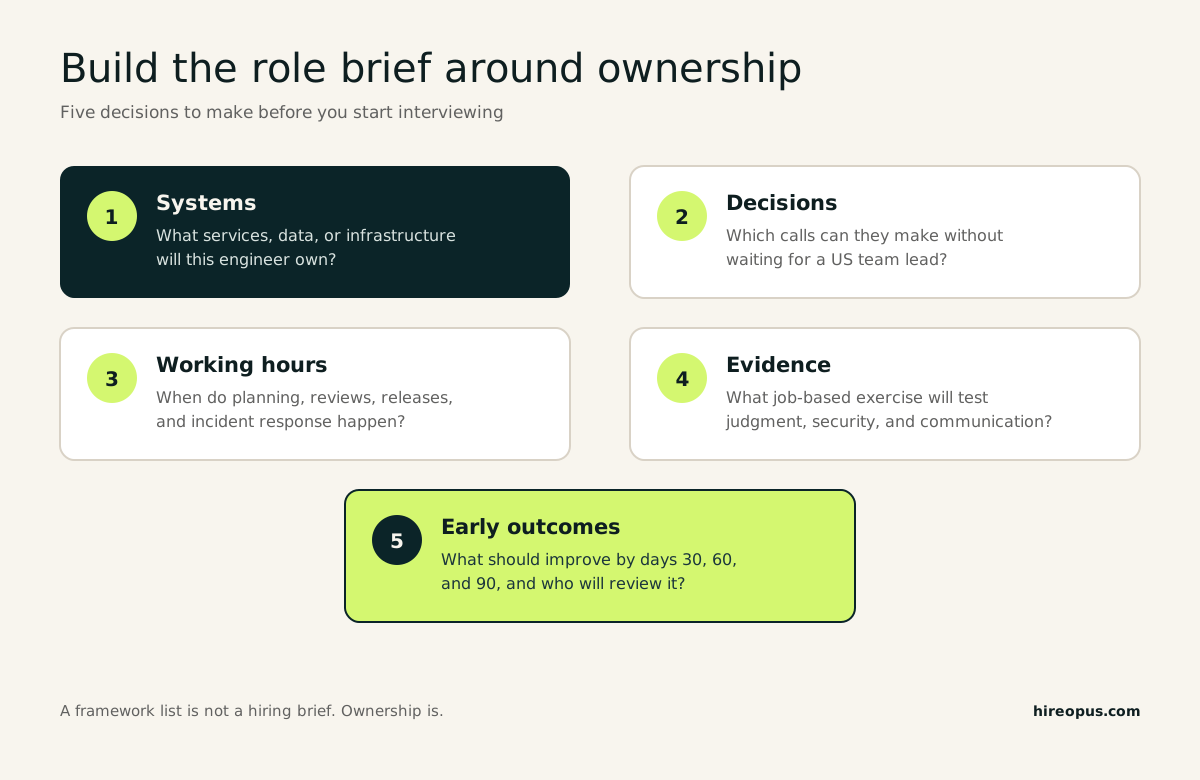
Write an ownership brief before you source candidates. Name the specific repositories the engineer will maintain, the architecture decisions they will make, and the concrete outcomes required in the first quarter. Use four fields:
- Systems owned: Name the applications, databases, and deployment pipelines the engineer monitors and updates daily.
- Decisions owned: Specify whether the candidate chooses third-party libraries, selects API patterns, or refactors legacy services without secondary approval.
- First outcomes: List two measurable goals for the first quarter, such as reducing errors on a specific endpoint or migrating a background job queue.
- Core competencies: Select four to six technical and operational abilities required to deliver those outcomes.
The U.S. Bureau of Labor Statistics last modified August 27, 2026 projects 10 percent employment growth for software developers, quality assurance analysts, and testers from 2025 to 2035, with about 106,100 openings projected each year. Use that outlook as context for a specific first screen. Ask for the system the engineer owned, the failure they handled, and the decision they made.
How many competencies should a senior engineering interview assess?
The September 2008 OPM guide says a structured interview is typically used to assess between four and six competencies. Use that range to keep the scorecard tied to the work.
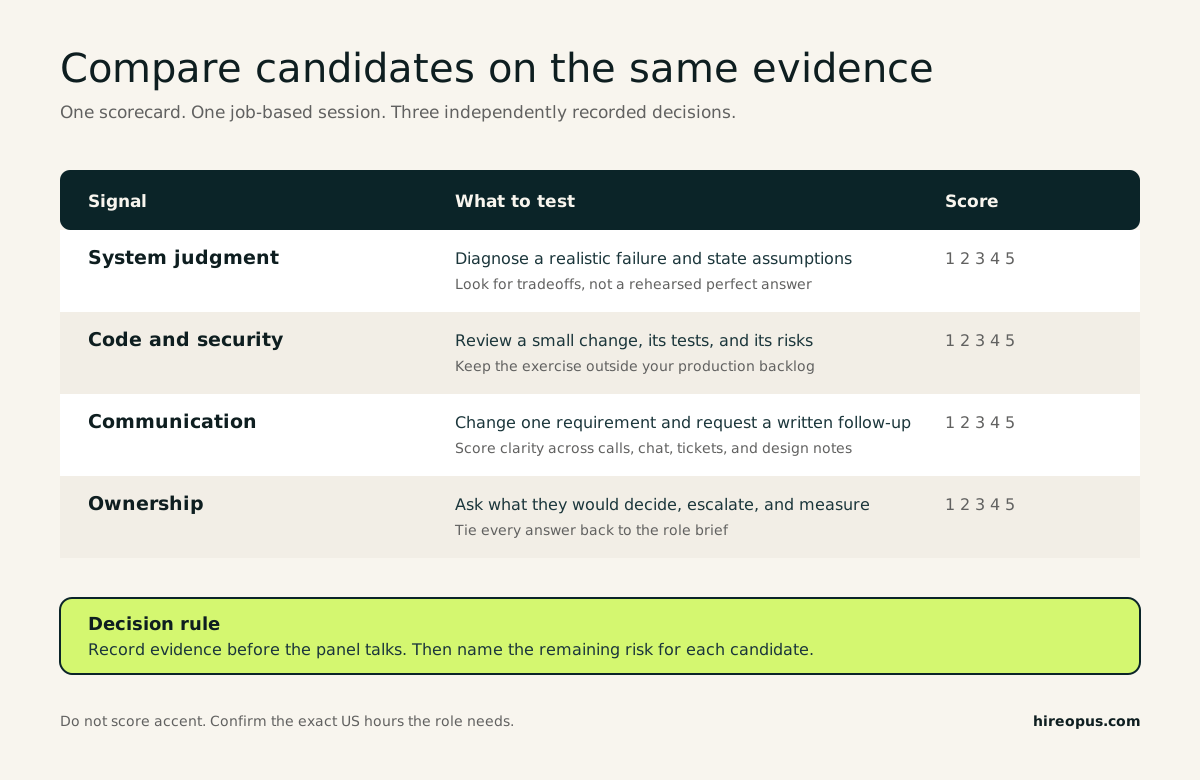
Build the scorecard around four to six competencies from the role brief. Choose competencies that match the work, such as system design, code quality, tradeoff evaluation, and operational troubleshooting. Define each one with observable behavior. For technical tradeoffs, ask the candidate to explain why they chose an architecture and what operational risks it creates.
Map each question to one competency. The OPM guide says structured interview questions should reflect job responsibilities, be open-ended, and be clear and concise. Ask the candidate to describe one system failure they resolved, how they found the cause, and how they checked the fix before release.
Establish a standardized rating scale across all interviewers. The OPM guide recommends a scale with five to seven proficiency levels, though a minimum of three levels is required to distinguish candidate performance. Each level must include concrete behavioral anchors. A middle rating for system design describes an engineer who builds a working architecture but misses edge-case failure modes. A top rating describes an engineer who identifies single points of failure, plans for network latency, and builds clear fallback paths without prompt.
Require every interviewer to submit a written score and one piece of behavioral evidence after the session. Cite what the candidate said or wrote. Use the shared rating scale in the debrief so the decision stays tied to the same evidence.
What should a practical technical exercise test?
A practical exercise tests how an engineer diagnoses issues, evaluates tradeoffs, and verifies fixes in real production environments. Avoid abstract algorithmic puzzles. Give the candidate a redacted repository or a system design scenario based on an actual problem your team solved.
The BLS outlook projects about 106,100 openings per year through 2035. Use that fact as context, not as a promise about your hiring result. The exercise should show whether the candidate can trace a failure, explain a tradeoff, and check the fix.
Structure the exercise as a 60-minute session divided into three distinct phases:
- System navigation: Give the candidate 15 minutes to review a codebase, trace data flow, and explain how the components interact.
- Diagnosis and tradeoffs: Ask the candidate to identify a performance bottleneck or bug, explain two possible solutions, and outline the technical tradeoffs of each approach.
- Verification: Have the candidate explain how they would test the fix in production without disrupting existing services.
Evaluate the candidate using a four-part rubric:
- Code comprehension: Did the engineer locate the relevant service and dependencies quickly?
- Architectural reasoning: Did the candidate account for edge cases, database load, and system dependencies when proposing a fix?
- Communication of technical risk: Can the engineer explain the risk of a deploy clearly to technical and non-technical stakeholders?
- Validation strategy: Does the candidate include automated tests and monitoring checks in their plan?
Record the candidate's answer beside the rubric. Keep the hiring decision tied to that evidence.
For infrastructure and reliability roles, use the senior DevOps hiring guide and incident exercise to evaluate change safety, operational judgment and on-call readiness.
How should you assess AI-assisted engineering judgment?
The 2025 Stack Overflow Developer Survey received over 49,000 responses from 177 countries across 62 questions. It reports that 84 percent of respondents use or plan to use AI tools in development, and 51 percent of professional developers use AI tools daily. The same survey reports that 66 percent of developers are frustrated by almost-right AI solutions, while 46 percent distrust the accuracy of AI tools and 33 percent trust it. Use the task to see whether the candidate catches those errors before code reaches production.
Give the candidate an AI-assisted code sample with seeded logic or performance defects. Ask them to write a short code review note and defend their recommendations in a brief conversation.
Look for these signals during the AI evaluation:
- The engineer identifies logical bugs or edge-case failures that automated tools generated.
- The engineer explains why an AI-generated suggestion fails security or architectural standards.
- The engineer refactors the generated code rather than accepting working output without verification.
- The engineer articulates the exact risk of deploying unverified AI output to production.
Do not score the candidate on whether the generated code looks polished. Score the review note. Look for the defect, the reason it matters, and the test that would catch it.
How do you test written communication and US hours?
Ask the candidate to write one decision note and join one session during the team's core US hours. Grade the same evidence across candidates.
GitLab's Guide to All-Remote, last modified August 19, 2026, says asynchronous workflows matter when multiple time zones are involved. It describes handbook-first documentation as "a single source of truth to lean on." Send the candidate a prompt about an architecture decision or a past incident. Ask for the problem, the tradeoffs, and the recommendation in a shared document within 24 hours.
Grade the response for a clear problem statement, an explicit tradeoff, and a recommendation that a non-technical teammate can follow. Ask one follow-up question when the candidate leaves a decision or risk unstated.
Run one live session during the team's core US hours. Observe attendance, real-time communication, and the candidate's answers to schedule questions. Confirm the schedule fits daily standups, code reviews, and incident response.
Give your hiring team a checklist for written communication and schedule fit:
- A brief written sample explaining a technical tradeoff in a shared document.
- Pass signals for writing: clear problem statements, explicit trade-offs, and no filler language.
- One live interview session scheduled during core US business hours.
- Pass signals for schedule: punctuality, real-time verbal clarity, and confirmed alignment with daily team standups.
Who should own contracts, payroll, benefits, and compliance when hiring in Latin America?
Set clear interview criteria, then assign administrative ownership. The Internal Revenue Service page, last reviewed or updated August 19, 2026, says worker classification depends on the specific facts in each case. The IRS framework distinguishes between control over the final result and control over how the work gets done, explicitly noting that a contract label alone does not determine the legal relationship. US engineering leaders should assign explicit operational ownership for every administrative task before extending an offer.
Your team should maintain an administrative ownership matrix before hiring across Latin America. Seek qualified legal or tax counsel to review local labor laws and tax obligations in each country where you engage talent.
- Technical selection: Your engineering leader makes the final hiring decision. Your recruiting partner handles sourcing and pre-screening.
- Contract execution: Your operations owner approves scope and the contract path. The assigned partner supports the contract handoff.
- Payroll questions: Your finance owner names who approves payroll records and who answers the team's questions.
- Benefits administration: Your operating owner names who answers benefit questions and records the handoff.
- Compliance records: Your named compliance owner keeps the required records and routes questions for qualified review.
Opus, a nearshore recruiting firm, places senior full-time talent from Latin America, with US companies. Opus handles contracts, payroll, compliance, and benefits. Your company manages the person's day-to-day work.
Opus starts with a scoping call, presents a shortlist of vetted candidates in about a week, and supports onboarding in about two weeks. Candidates placed by Opus work US hours in fluent English. Opus provides a lifetime replacement guarantee on every placement and reports 97% one-year retention.
Frequently asked questions
How do I hire senior software engineers in Latin America?
Define system ownership before sourcing. Use four to six competencies and a practical exercise. Add a written decision note and a live US-hours session. Assign a clear owner for contracts, payroll, benefits, and compliance.
What should a senior engineer practical interview include?
Start with 15 minutes of codebase navigation. Then ask the candidate to diagnose a defect and compare possible fixes. Finish by asking how they would verify the change in production.
How do you test AI-assisted engineering judgment?
Give the candidate AI-generated code with seeded logic or performance defects. Score whether they find the defect and explain its production risk. Their review note should name the test that catches it.
How do you test written communication and US-hours fit?
Ask for a written decision note within 24 hours. Run one live session during the team’s core US hours. Grade the same evidence for every candidate.
Who handles payroll and compliance when hiring in Latin America?
Assign named owners before extending an offer. Opus handles contracts, payroll, compliance, and benefits for the senior full-time talent it places.